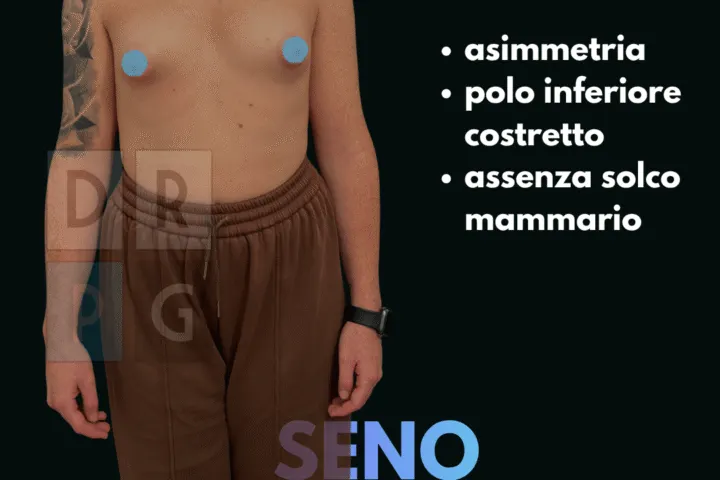
Mounjaro and body changes: what happens after weight loss and what treatments can help
Mounjaro has profoundly changed the way obesity and overweight are treated in selected patients today.
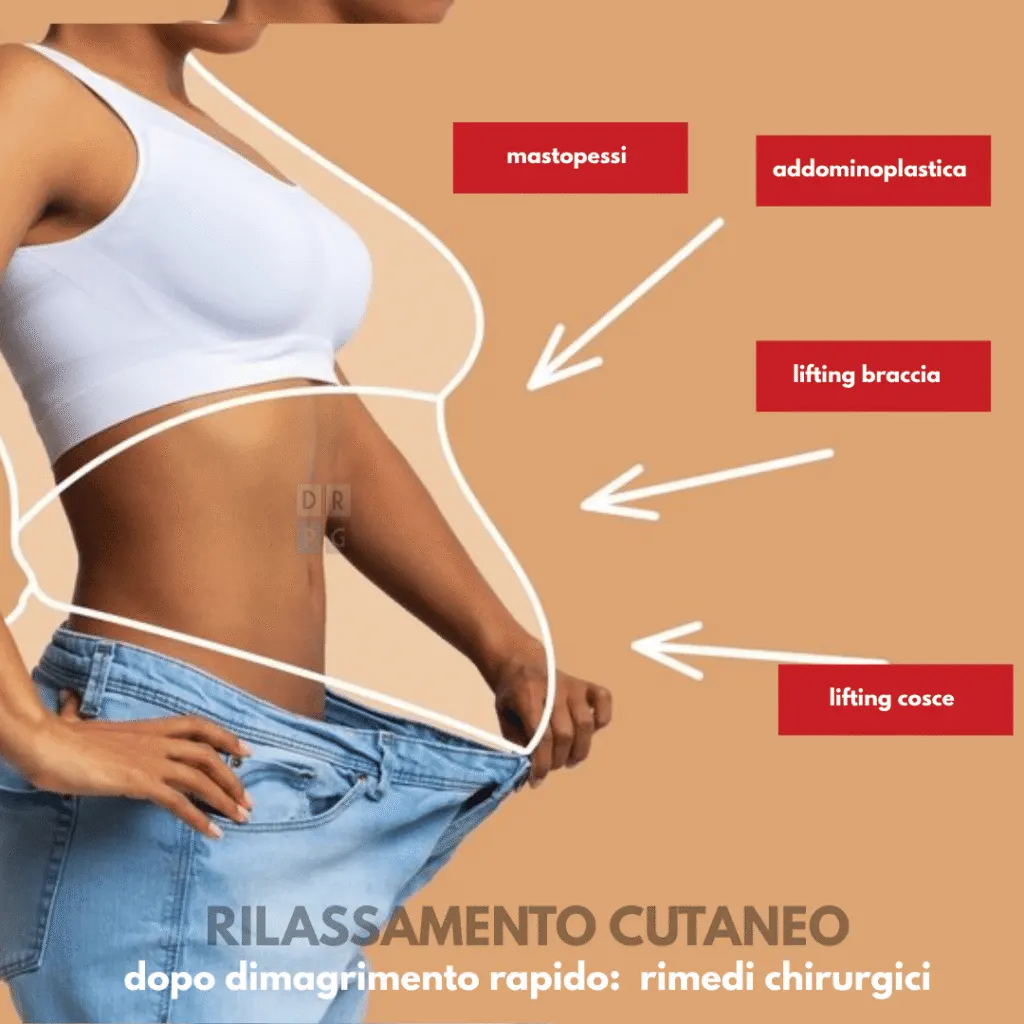
Tirzepatide can cause significant weight loss, and when the body changes rapidly, its appearance can also change: the face may appear hollower, the breasts may lose volume, the abdomen may show greater skin laxity, and even the buttocks, arms, and thighs may change.
But it is important to clarify a concept immediately:
It is not correct to simply say that Mounjaro “makes the skin fall off” or “empties the face”.
Many of these changes are mainly linked to the amount of weight loss, the speed with which it occurs, the loss of adipose tissue that supported certain areas, and the individual characteristics of the skin.
In this guide we will see what can happen to the body during significant weight loss with Mounjaro and which aesthetic medicine and surgery treatments can be evaluated once the new body balance has been achieved.
By Dr. Pierluigi Gigliofiorito – Plastic Surgeon in Milan and Caserta
Dr. Pierluigi Gigliofiorito specializes in Plastic, Reconstructive, and Aesthetic Surgery. He specializes in breast surgery, liposuction, and body contouring, advanced fillers, and combined facial and buttock treatments. He practices in Milan, Caserta, and Rome.
What is Mounjaro and why can it change the body so much?
Mounjaro is the trade name for tirzepatide , a drug that acts on the GIP and GLP-1 receptors.
It is used, according to the authorized indications and under medical supervision, in the treatment of type 2 diabetes and for weight management in certain people with obesity or overweight associated with related conditions.
One of the most noticeable effects can be a significant reduction in body weight.
In the SURMOUNT-1 study, in obese or overweight patients without diabetes, mean weight reduction at 72 weeks reached approximately 15% with 5 mg, 19,5% with 10 mg and 20,9% with 15 mg of tirzepatide.
When a person loses 15–20% or more of their weight, it's not just the number on the scale that changes.
The volumes of the body change.
And this is precisely the point of interest for the plastic surgeon.
Does Mounjaro only make you lose fat?
No.
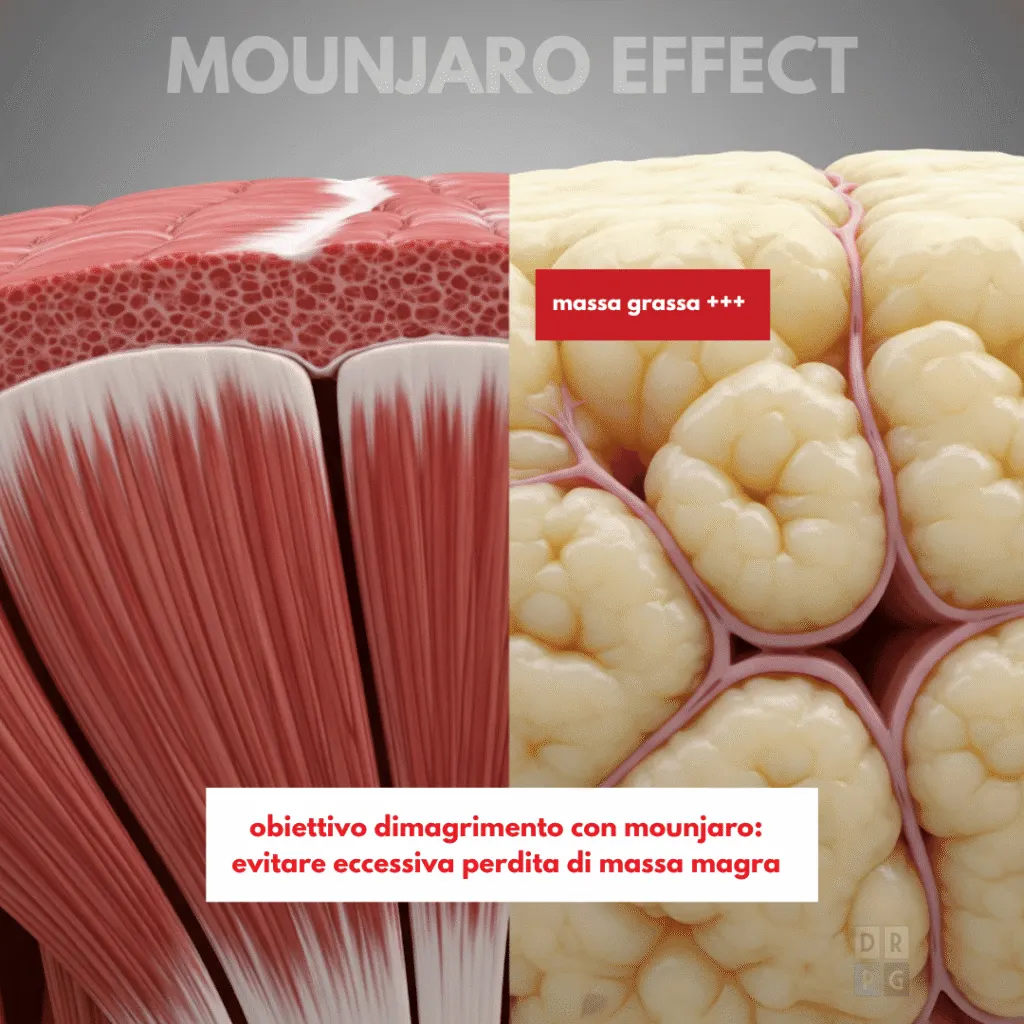
Weight loss mainly involves fat mass, but may also involve lean mass.
A substudy of the SURMOUNT-1 study assessed body composition using DEXA. After 72 weeks of treatment with tirzepatide, the mean reduction was 33,9% for fat mass and 10,9% for lean mass.
In terms of the composition of the weight lost, approximately:
- 75% was fat mass
- 25% was lean mass
This doesn’t mean that Mounjaro “destroys muscle”: some loss of lean mass normally occurs during major weight loss.
However, it does mean that during the journey it is important not to evaluate exclusively the kilos lost.
Body composition, nutrition, protein intake and physical activity become particularly important , especially in older people or when weight loss is very significant.
Mounjaro and loose skin: why can it happen?
The skin gradually adapts to changes in body volume.
When a person loses a lot of weight, especially after years of being overweight, the skin that previously had a larger volume may not retract completely.
The result depends on several factors:
- age
- genetics
- skin quality and elasticity
- amount of weight lost
- speed of weight loss
- duration of previous overweight
- sun exposure
- smoke
- body fat distribution
- quality of muscle mass.
This is why two people who lose the same amount of weight can have completely different body shapes.
And especially:
Not all loose skin requires surgery.
The solution depends on the area affected and the degree of laxity.
What can happen to different areas of the body after Mounjaro?
1. Empty face after Mounjaro: the so-called “Mounjaro face”
Terms like “Ozempic face” or “Mounjaro face” are used to describe the more hollow appearance some people experience after significant weight loss.
This is not a specific disease caused by the drug.
Reducing subcutaneous fat in the face can make the following more evident:
- hollowed out temples
- loss of volume of the cheekbones
- nasolabial folds
- eye bags
- less defined jawline
- neck laxity
- previously less visible wrinkles.
What treatments can help?
The strategy depends on the type of change.
In mild or moderate cases the following may be evaluated:
- hyaluronic acid filler
- biostimulation
- skin quality treatments
- collagen stimulation techniques
- facial lipofilling in selected patients.
The goal should not be to simply “fill” the face, but to harmoniously reconstruct the volumes that have changed during weight loss.
However, when skin laxity is significant, aesthetic medicine may not be sufficient and surgical evaluation may be indicated.
2. Mounjaro and empty breasts after weight loss
The breast contains a significant component of adipose tissue.
When weight decreases significantly, breast volume may then decrease.
Some women observe:
- loss of the upper pole
- more “empty” breast
- greater visibility of ptosis
- less tight skin
- nipple apparently lower
- overall volume reduction.
Even in this case, it is not Mounjaro who directly lowers the breasts : it is above all the change in volume resulting from weight loss.
What can you do?
It depends on what's left after weight loss.
If the volume has decreased but the breast has not significantly sagged , breast augmentation may be considered .
If ptosis is predominantly present , a mastopexy may be more appropriate.
If both emptying and ptosis are present , a mastopexy associated with prostheses or, in selected cases, lipofilling may be indicated.
The choice must be personalized based on the residual anatomy and the patient's goal.
To better understand when it may be sufficient to restore volume and when it is also necessary to lift the breasts, you can learn more about the differences between breast augmentation and mastopexy.
3. Mounjaro and relaxed abdomen
The abdomen is probably one of the areas where the difference between fat loss and skin quality becomes most noticeable.
After significant weight loss, abdominal fat can decrease significantly, but it can remain:
- relaxed skin
- skin folds
- abdominal apron in the most important cases
- pre-existing rectus diastasis
- residual localized adiposity.
And this is where we need to make a clear distinction between liposuction and abdominoplasty.
If localized fat remains
Liposuction can be useful for reshaping residual fat deposits in a person with sufficiently elastic skin.
If after weight loss localized fat remains but the skin retains good elasticity, it may be useful to learn more about how liposuction works and when it is actually indicated.
If the main problem is excess skin
Liposuction alone does not remove skin.
When the excess skin is significant, it may be necessary to evaluate an abdominoplasty , possibly combined with correction of the muscle wall when indicated.
However, when excess skin, sagging abdominal wall, or diastasis recti prevail, the procedure is different: in the guide on abdominoplasty and diastasis correction, I explain which problems this procedure can correct.
In some patients, the two techniques can be combined as part of a lipoabdominoplasty.
4. Mounjaro and empty buttocks: what does “Ozempic butt” mean?
Losing weight can also significantly change the buttocks.
Fat loss can lead to:
- volume reduction
- minor projection
- flattening of the upper pole
- greater emphasis on hip dips
- skin laxity
- greater visibility of cellulite.
In the United States, the term “Ozempic butt” has become popular , but the phenomenon is not exclusive to Ozempic and does not identify a specific pathology.
It simply describes the change in volume and shape of the buttocks that can appear after significant weight loss.
How can you recover the volume of your buttocks?
There are several possibilities.
Buttock fillers
It may be indicated when you want a moderate augmentation, improve projection, or correct hip dips without surgery.
G-Fill
In selected patients, a combined approach can be used that works not only on the volume, but also on the irregularities and aesthetic quality of the gluteal region.
When weight loss primarily results in a reduction in projection or makes hip dips more evident, gluteal fillers with hyaluronic acid or polylactic acid may represent one of the non-surgical options to evaluate.
Buttock Lipofilling / BBL
If sufficient fat is available in other areas of the body, lipofilling can allow you to increase the volume of the buttocks using autologous fat and simultaneously reshape the silhouette using liposuction.
After significant weight loss, however, the problem may be predominantly skin-related: in these cases, adding volume isn't always the right solution, and the degree of sagging must be assessed.
However, fillers and lipofilling don't achieve the same results. This guide, "BBL vs. Buttock Fillers: Which One to Choose?", compares the achievable volume, duration, recovery, and indications for the two techniques.
5. Relaxed arms after weight loss
The inner region of the arms may clearly show the loss of skin elasticity.
In mild cases, it may be useful to evaluate treatments aimed at improving the quality and retraction of the skin.
However, when there is a real excess of skin, especially after significant weight loss, the surgical treatment of choice may be brachioplasty.
The fundamental difference is therefore understanding whether the problem is:
residual fat → moderately loose skin → true excess skin.
These are three different conditions and require different strategies.
6. Thighs and inner thighs
Even the thighs can change significantly after significant weight loss.
The areas most frequently affected are:
- inner thigh
- suprapatellar region
- lateral part of the thigh
- subgluteal region.
If localized fat accumulation prevails, liposuction may be considered.
In patients with localized fat deposits, it can be useful to distinguish between simple fat reduction and true reshaping of proportions: I explored this difference in depth in the guide Liposuction vs. Liposculpture: What's the Difference?
However, when excess skin prevails, in the most serious cases it may be necessary to consider a thigh lift.
Mounjaro and Muscles: Why Sport Becomes Important
This is an aspect that is often underestimated.
The aesthetic result of weight loss depends not only on how much fat is lost , but also on what remains under the skin.
Good muscle mass contributes to the shape of:
- buttocks
- thighs
- arms
- shoulders
- trunk.
For this reason, during a weight loss program, physical activity, and in particular an adequate resistance training program , can be important for maintaining strength and muscle mass.
Muscle training cannot eliminate true excess skin, but it can significantly contribute to the quality of body composition.
Mounjaro and proteins: why are they important?
Severely reduced appetite may make it more difficult to achieve adequate nutritional intake in some patients.
This aspect becomes particularly important when combining:
- significant weight loss
- old age
- low physical activity
- reduced protein intake
- scheduling a surgical procedure.
Adequate proteins and micronutrients are also essential for healing processes.
For this reason, especially before a body contouring procedure, the nutritional status must be evaluated and optimized.
There is no one-size-fits-all amount of protein: needs, kidney function, age, weight, body composition, and clinical conditions must be considered individually.
When to have plastic surgery after weight loss with Mounjaro?
This is one of the most important questions.
In general, it is not ideal to schedule body contouring surgery while your weight is still changing rapidly.
In fact, if the patient continues to lose weight after the surgery, the aesthetic result may change further.
It is therefore preferable to evaluate:
- how much weight was lost
- if the weight is now stable
- body composition
- nutritional status
- excess amount of skin
- any associated pathologies
- ongoing drug therapy
- realistic patient goal.
Therefore, there is no automatically valid number of months for everyone.
Weight stability and overall clinical condition are more important than a pre-established deadline.
Should I stop Mounjaro before surgery?
This decision should not be made independently by the patient.
Drugs that act on the incretin system can slow gastric emptying, and this is relevant to anesthesia.
Perioperative management has evolved in recent years and must be established on a case-by-case basis based on the drug used, dose, phase of therapy, gastrointestinal symptoms, type of surgery, and the facility's anesthesiology protocol.
The surgeon, the anesthetist and the doctor managing the therapy must therefore coordinate before the operation.
Which treatment should I choose after Mounjaro?
There is no “post-Mounjaro treatment”.
However, there is a body that has changed weight and proportions and must be re-evaluated in its new anatomy.
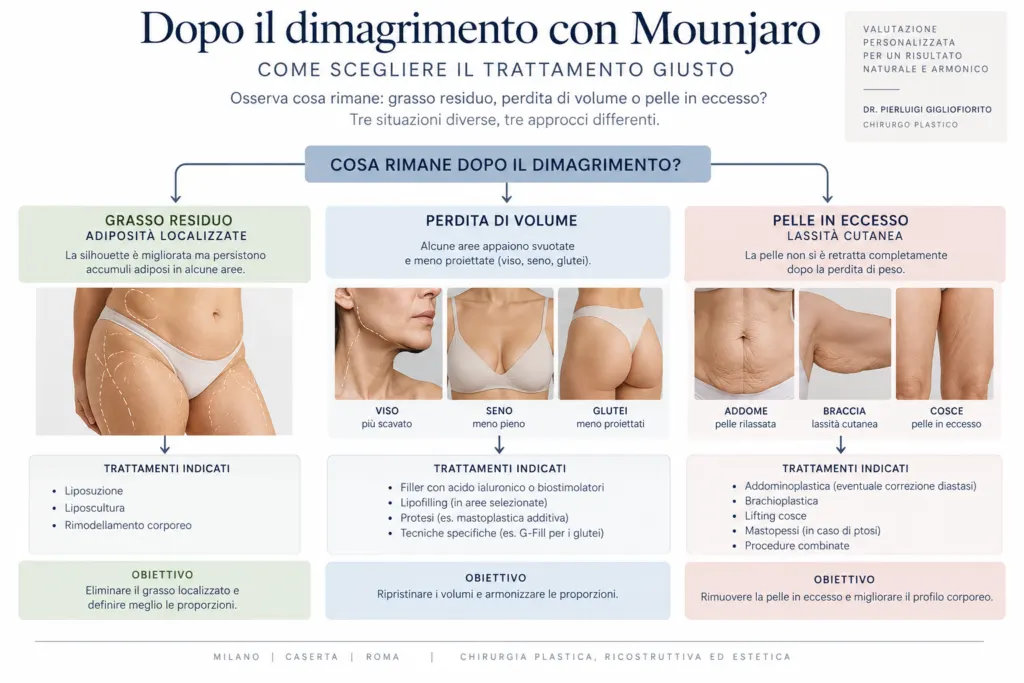
| Problem after weight loss | Possible options to evaluate |
|---|---|
| Empty face | fillers, biostimulation, lipofilling |
| Significant laxity of the face/neck | surgical evaluation |
| Empty breasts | breast augmentation / lipofilling in selected cases |
| Sagging breasts | mastopexy |
| Empty and sagging breasts | mastopexy ± prosthesis |
| Residual abdominal fat | liposuction |
| Excess abdominal skin | abdominoplasty |
| Not very projected buttocks | buttocks filler / G-Fill / lipofilling |
| Glutes with significant laxity | personalized body contouring evaluation |
| Localized fat on the thighs | liposuction |
| Very relaxed skin on the thighs | thigh lift |
| Excess skin on the arms | brachioplasty |
The visit serves to distinguish between volume loss, residual fat and excess skin , because they are often perceived by the patient as the same problem but require completely different treatments.
The best time to intervene: during or after weight loss?
When losing weight, the main goal should be to maintain health, muscle mass, and good nutritional quality.
Some non-surgical treatments can also be evaluated during the process, especially when they are aimed at skin quality.
For body contouring surgeries, however, it is generally more rational to wait until weight has stabilized and it is possible to understand what the final anatomy will actually be.
In other words:
First the bodily change is completed, then it is decided what is really worth correcting.
FAQs about Mounjaro and body changes
Not directly. Significant weight loss can leave excess or increased skin laxity, especially when the skin has a reduced ability to retract. Age, amount of weight lost, genetics, and skin quality greatly influence the outcome.
It's a non-medical term used to describe the loss of volume and increased facial sagging that can become evident after significant weight loss. It's primarily related to the reduction of facial fat and changes in volume.
Significant weight loss can reduce the fatty component of the breast and make the breasts less full or highlight pre-existing ptosis. This is not a direct effect of tirzepatide on the breasts.
Fat loss can also affect the buttocks, reducing their volume and appearance. The amount of change varies greatly from person to person.
In many cases, yes. Depending on the anatomy, muscle training, gluteal fillers, biostimulation, G-Fill, or lipofilling may be considered. In the presence of significant excess skin, the strategy may vary.
No. Training can improve muscle mass, strength, and body composition, but it can't eliminate actual excess skin. However, it can significantly improve the underlying body shape.
There's no one-size-fits-all timeframe. It's best to have completed substantial weight loss, maintain a stable weight, and maintain adequate nutritional status before scheduling major body contouring.
Yes, if there's a surgical indication. However, it's best to evaluate your breasts once your weight is stable, as further weight changes can alter their volume and shape again.
It can be considered when the primary problem is a moderate loss of volume or projection. If, however, there is marked skin laxity, simply adding volume may not be the best solution.
The decision should be made together with the surgeon, anesthesiologist, and the doctor prescribing the therapy. You should not stop the medication on your own.
My opinion as a plastic surgeon
The arrival of drugs capable of causing significant weight loss is creating a new type of patient in plastic surgery.
The problem is no longer just “how to lose fat” , but often becomes:
“How to harmonize your body after losing fat.”
And it's a substantial difference.
After significant weight loss, you don't automatically need to add volume or eliminate more fat.
First we need to understand what has really changed:
- volume
- cute
- muscle
- proportions.
A patient with a sagging abdomen may not need further liposuction.
A patient with sagging breasts may not simply need a prosthesis if there is also significant ptosis.
A sagging buttock may require volume, but a buttock with significant skin laxity requires a different reasoning.
The correct treatment therefore arises from the analysis of the new anatomy after weight loss, not from the name of the drug used to achieve it.
Conclusions
Mounjaro can lead to very significant weight loss in properly selected patients who are monitored by a doctor.
When weight loss is significant, the face, breasts, abdomen, buttocks, arms and thighs can also change.
Not all of these changes require treatment, and there is no single procedure that can correct them all.
Physical activity, proper nutrition, weight stabilization, aesthetic medicine and plastic surgery have different roles.
Specialist assessment allows us to distinguish what can be improved through lifestyle changes from what can benefit from medical-aesthetic treatment or surgery.
Did you lose weight with Mounjaro and did your body change?
If after losing weight you've noticed sagging breasts or buttocks, abdominal sagging, or facial changes, during your visit we can assess which changes are due to volume loss, which to the skin, and which to body composition.
The goal is not to recover the previous body, but to harmonize the new body after weight loss , choosing only the treatments that are truly indicated.
Visits to Milan, Caserta and Rome.
The information contained in this article is for informational purposes only and does not replace the advice of a physician. Mounjaro (tirzepatide) is a prescription drug, and indications, contraindications, dosage, continuation, or discontinuation of treatment must be determined by the attending physician/specialist. Aesthetic and surgical treatments must be evaluated individually. Results may vary from patient to patient.
Bibliography
- Jastreboff AM, et al. Tirzepatide Once Weekly for the Treatment of ObesityNew England Journal of Medicine. 2022;387:205–216. The SURMOUNT-1 study documents mean losses of up to 20,9% at 72 weeks.
- Look M, et al. Body composition changes during weight reduction with tirzepatide in the SURMOUNT-1 studyDiabetes Obes Metab. 2025. DXA substudy documents approximately 75% fat mass and 25% lean mass in weight loss.
- Mehta M, et al. Nutritional Challenges in Post-Massive Weight Loss Body Contouring: Guidance for Plastic Surgeons on GLP-1 Agonists and Sleeve Gastrectomy. Plast Reconstr Surg. 2025. Particularly relevant for nutrition, protein, healing, and post-weight loss surgery.
- Nonsurgical Aesthetic Treatment of the Face and Neck in GLP-1 Receptor Agonist Weight Loss PatientsAesthetic Surgery Journal. 2026. Describes midfacial volume loss, hollowing, and laxity and discusses multimodal approaches.
- GLP-1 Receptor Agonists in Aesthetic Surgery: A Narrative Review on Perioperative Safety, Sarcopenic Morphologies, and Adapted Body Contouring Strategies. Aesthetic Plast Surg. 2026.
- EMA. Mounjaro – European Public Assessment ReportFor updated guidance and regulatory information.
- #abdominoplasty
- #bodycontouring
- #plasticsurgery after Mounjaro.
- #plastic surgery.
- #weightloss
- #glutes
- #mastopexy
- #mounjaro
- #Mounjaro weight loss
- #Mounjaro and sports
- #Mounjaro face
- #Mounjaro buttocks
- #Mounjaro muscle mass
- #Mounjaro relaxed skin
- #Mounjaro breast
- #Mounjaro face
- #saggy skin after weight loss
- #relaxed skin
- #tirzepatide