
When a patient seeks information about the Motiva prosthetics catalog, it's not actually looking for a list of models.
He's trying to understand Which prosthesis to choose for your body, without getting lost among acronyms, forms and commercial names.
In this article I explain the Motiva catalog from a clinical point of view, clarifying what really matters in the choice and what, instead, risks only confusing.
By Dr. Pierluigi Gigliofiorito – Plastic Surgeon in Milan and Caserta
Dr. Pierluigi Gigliofiorito is a plastic surgeon specializing in breast augmentation, HD liposuction, and buttock fillers. He is the creator of proprietary techniques and practices in Milan, Caserta, and Rome.
My clinical experience
Many patients arrive for a visit after consulting the Motiva catalog for hours, convinced that they have already identified the right prosthesis.
In reality, the final choice is almost always different from the one initially imagined.
The reason is simple: the catalog shows the technical characteristics of the prostheses, while the surgeon must choose the device best suited to the patient's anatomy, the quality of the tissues, and the desired long-term result.
For this reason, I consider the catalogue an excellent information tool, but not a decision-making tool.
Why the Motiva Implant Catalog Can Be Confusing
The Motiva catalog is structured to guide a surgical choice, not to describe a result.
For this reason, many patients arrive for a visit with already formed ideas about:
- model names
- “trendy” shapes
- selected volumes online
The problem is that the prosthesis is not chosen only from the catalogue, but based on the patient's body.
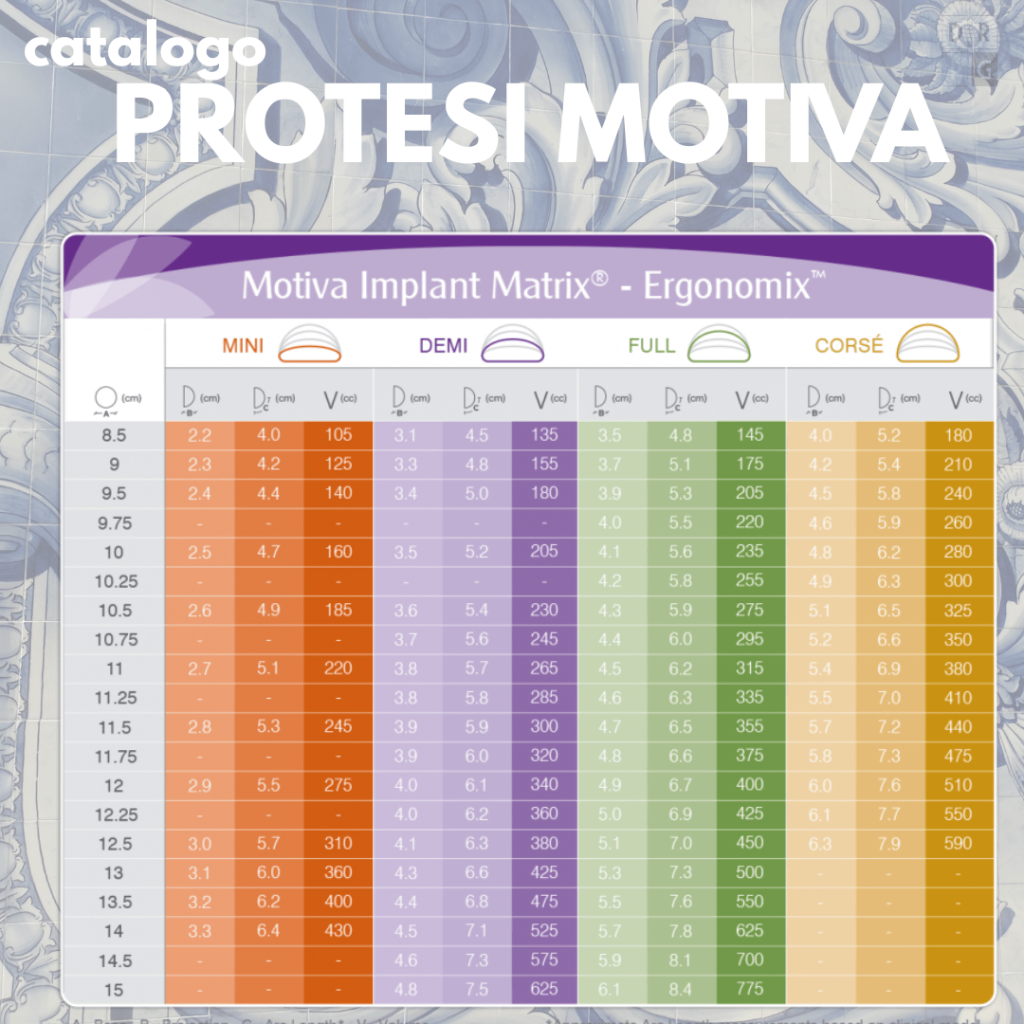
Motiva Prosthetics Families: What It Really Means
The Motiva catalog offers various lines and configurations. From a clinical perspective, however, the key distinction is:
- behavior of the prosthesis in the tissues
- adaptation over time
- shape stability
- compatibility with the patient's anatomy
The trade name counts less than how that prosthesis will behave in your specific case.
What do I actually look at during the visit?
When choosing a Motiva prosthesis, I generally consider:
✔ width of the breast base
✔ leather quality
✔ thickness of the fabrics
✔ position of the areolas
✔ possible emptying of the breast
✔ patient expectations
These parameters influence the final result much more than the commercial name of the prosthesis.
How do I interpret the catalog during the visit?
| Clinical situation | General trend |
|---|---|
| Thin patient with thin tissues | More natural and less projecting prostheses |
| Patient with broad chest | Possibility to use larger volumes |
| Empty breast after pregnancy | Evaluation for a mastopexy |
| Very elastic skin | Greater freedom in choosing the profile |
| Request for a very natural result | Trend towards less projecting prostheses |
| Request for more evident décolleté | Possible indication for more projected profiles |
| Breast asymmetries | Customized choice of size and profile |
| Breast ptosis | Evaluation of associated mastopexy |
👉 This table does not replace a specialist visit, but it helps understand why two patients may receive completely different indications even though they choose prostheses from the same catalog.
Shape of the prosthesis: it is not an "absolute" aesthetic choice
One of the most common questions is:
“Is a more natural or more projected prosthesis better?”
From a surgical point of view:
- the shape must be chosen based on the chest, gland and skin
- a prosthesis projected too much onto unsuitable tissues leads to unnatural results
- a “natural” prosthesis is not such if it is poorly indicated
The catalog offers options, but the decision is clinical, not graphics.
Surface and softness: what really affects the result
One of the most frequently cited points in research on Motiva concerns:
- softness
- sensation to touch
- integration with tissues
These aspects do not depend only on the prosthesis, but on:
- positioning plan
- quality of fabrics
- post-operative management
The catalog cannot predict these variables, but the surgeon can.
Volumes: Why the Catalogue is Misleading
The Motiva catalog features a wide range of volumes.
Ma the volume should never be chosen in the abstract.
Common mistakes:
- choose a volume “seen on another person”
- rely only on the cc
- ignore chest width and breast base
The same prosthesis can appear:
- natural on a patient
- excessive or unnatural on another
Two aspects must be remembered:
- the volume of the prosthesis adds to that of the breast (therefore the same prosthesis will have different effects on two patients)
- the prosthesis is chosen on the basis of the breast, that is, the width of the breast.
Take a look at thearticle dedicated to the choice of prosthesis!
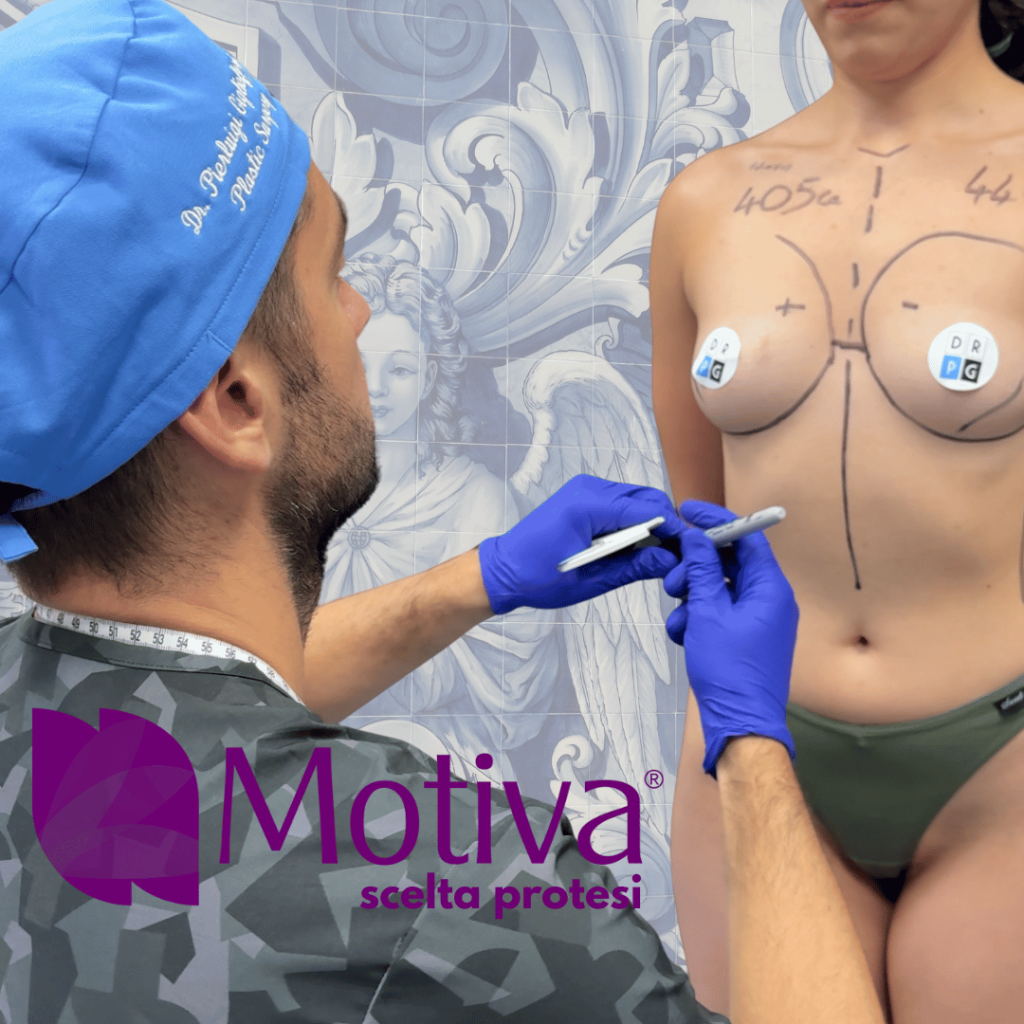
The false myth of cubic centimeters
One of the most common mistakes is choosing the prosthesis based exclusively on the cc.
In reality, 300 cc can appear very different on two different patients.
The same volume can produce:
- a natural result on a tall, broad-chested woman;
- a much more evident result on a small patient.
For this reason, volume represents only one of the elements I consider when planning the intervention.
Motiva Prosthesis and Mastopexy: A Point to Clarify
This is one aspect that in the catalogue it is not clearly explained.
From my clinical point of view:
- I do not use Motiva prostheses in cases of mastopexy
- stability over time is essential in these interventions
- other solutions offer greater long-term reliability
It is a concrete example of how catalog and clinical practice do not always coincide.
Catalog and clinical reality are not the same thing
A catalog can describe technical features.
However, it cannot foresee:
- behavior of tissues over time;
- leather quality;
- individual healing;
- stability of the result;
- breast evolution over the years.
For this reason, the final choice always arises from the combination of the characteristics of the prosthesis and the surgeon's clinical experience.
How to really choose a Motiva prosthesis
In summary, the correct choice does not start from the catalogue but from:
- anatomy analysis
- skin quality
- realistic goal
- type of surgery (breast augmentation vs. mastopexy)
- expectations over time
The catalog is useful after, not before.
FAQ
It is an informative tool, but does not replace clinical evaluation.
No. There is a prosthesis that is best suited to the patient.
You can make a wish, but the final choice must be medical.
Only if contextualized on the correct anatomy.
There is no universally best or most commonly used prosthesis. The choice depends on the patient's anatomical characteristics and the desired aesthetic goal.
The catalog can help you understand the different options available, but the final volume is chosen during the visit based on the width of the chest, the starting breast, and body proportions.
No. The catalog describes the characteristics of the prostheses but cannot predict how the result will appear on a specific patient.
Conclusion
The Motiva prosthetics catalog is not a list of aesthetic options, but a set of tools.
The difference between a good result and an excellent result is not in the name of the prosthesis, but in the way it is chosen and used.
If you're considering breast augmentation and want to know which implant is right for you, a specialist visit is the only step that really matters.
Want to know if Motiva ergonomic prosthetics are right for you?
Book one specialist at my offices in Milan o Campania (Naples/Caserta area).
We will evaluate anatomy, proportions, and aesthetic goals to choose the most appropriate implant—with a serious and personalized medical approach.
The information on this site is for informational purposes only and does not replace the advice of your doctor during your visit. Each treatment is individually evaluated. Clinical case. Results may vary from patient to patient. No content is for promotional purposes. nor does it intend to encourage the performance of medical procedures.