Protruding labia minora: When is it normal and when is labiaplasty indicated?
By Dr. Pierluigi Gigliofiorito – Specialist in Plastic, Reconstructive and Aesthetic Surgery
“My labia minora are protruding: is this normal?”
It's a question many women ask during an intimate surgery appointment, often after years of thinking there's something wrong with their body.
Sometimes the initial reason is aesthetic, but during the examination, a functional component also emerges. This is what happened to one of my patients, whose case we'll discuss later.
The first thing to clarify is that there is no single or "correct" shape of the vulva . The labia minora can be short or more developed, symmetrical or different from each other, and they can remain contained within the labia majora or protrude beyond them.
All of these characteristics may be part of normal anatomical variability. Scientific societies also emphasize that the size, shape, and color of the external genitalia vary significantly from one woman to another.
The question then should not simply be:
“Are my labia minora too big?”
but rather:
“Is my anatomy causing me a real problem, and if so, what is the most appropriate treatment?”
And it is precisely from this distinction that a correct evaluation should begin.
Protruding labia minora: Is it normal?
Yes. The fact that the labia minora are visible or protrude beyond the labia majora does not, in itself, mean that a malformation exists or that surgery is necessary.
There is great variability in the morphology of female genitalia. Some asymmetry between the two sides is also common.
Furthermore, the appearance of the vulva can change throughout life in relation to pubertal development, pregnancy, aging and hormonal changes.
For this reason, I prefer not to judge the surgical indication simply on the basis of a measurement in centimeters.

A clinical case: when the aesthetic problem is associated with functional disorders
A patient of mine came to me for a problem that had been bothering her for many years.
From a young age, she perceived her labia minora as particularly large and protruding . This appearance caused her discomfort, especially at the beach, because in some of her more restrictive swimsuits, she felt they might be visible.
For a long time, however, he had considered the question exclusively aesthetic.
Over time, a second problem had been added: discomfort during sexual intercourse and frequent episodes of local irritation and inflammation.
It was while searching online for information on these disorders that the patient found some of my content on intimate surgery and began to wonder whether the aesthetic problem she had always perceived and the functional disorders could be connected.
The visit: it is not enough to establish that the labia minora are "large"
During the visit, the key issue was not whether her labia minora were simply too large by a certain measurement.
We evaluated her anatomy and especially the relationship between the conformation of the labia minora and the disorders she reported.
This step is important because irritation, inflammation, or pain during intercourse shouldn't automatically be attributed to the size of the labia minora . Before proposing a surgical solution, it's necessary to evaluate the clinical picture and consider any other possible causes of the symptoms.
In her case, the visit allowed us to discuss both the aesthetic component, which had been present for many years, and the functional one that had subsequently led her to seek a solution.
Why in this case we evaluated labiaplasty
After the evaluation, we discussed the possibility of a reduction labiaplasty , with the aim of reshaping the excess tissue while respecting the anatomy of the region and preserving its function.
The decision was therefore not simply born from the fact that the labia minora protruded.
It was born from the combination of several elements:
- patient anatomy;
- aesthetic discomfort present for many years;
- reported disorders during intercourse;
- recurrent episodes of local irritation;
- patient expectations;
- individual clinical evaluation.
And it is precisely this case that explains why there is no measurement of the labia minora that, by itself, determines who should undergo surgery.
What does this case teach us?
A woman can have protruding labia minora without any problems and without requiring any treatment.
In another woman, however, a certain anatomical conformation may be associated with rubbing, irritation or discomfort during certain activities or during sexual intercourse.
It's not just the looks that make the difference.
For this reason, during an intimate surgery visit I try to answer three questions first:
Could the patient's complaint really be related to her anatomy?
Are there other possible causes that need to be ruled out?
Can any intervention realistically meet your expectations without compromising function?
Only after these evaluations does it make sense to discuss whether labiaplasty could represent an option.
Is there a point beyond which the labia minora are too large?
There is no universal value that allows us to say:
“beyond this limit we must operate”.
Several anatomical classifications of labia minora hypertrophy have been proposed, but the dimensions must be interpreted in the context of the individual patient.
In fact, ACOG explicitly emphasizes that anatomical measurements should not be used alone to determine the appropriateness of surgery.
It is therefore more correct to evaluate together the anatomy, any symptoms, expectations and motivation of the patient.
When can labia minora become a problem?
In some women, greater development or a particular conformation of the labia minora may be associated with functional disorders.
Among those most frequently reported during the visit may be:
- rubbing and irritation with certain clothing;
- discomfort while running, at the gym, cycling or other sports activities;
- difficulty or pain during certain intercourses;
- discomfort when the labia minora are compressed or pulled together;
- recurring irritations;
- difficulties in the daily management of the area;
- significant discomfort related to one's anatomy.
ACOG also recognizes that, although less common, enlarged or asymmetrical labia may interfere with clothing, exercise, or sexual activity.
However, it is important to distinguish these problems from other gynecological, dermatological or vulvar conditions that can cause similar symptoms.
Not all vulvar discomfort is due to the size of the labia minora.
How can you tell if you really have hypertrophy of the labia minora?
During an examination I don't just evaluate "how much they protrude".
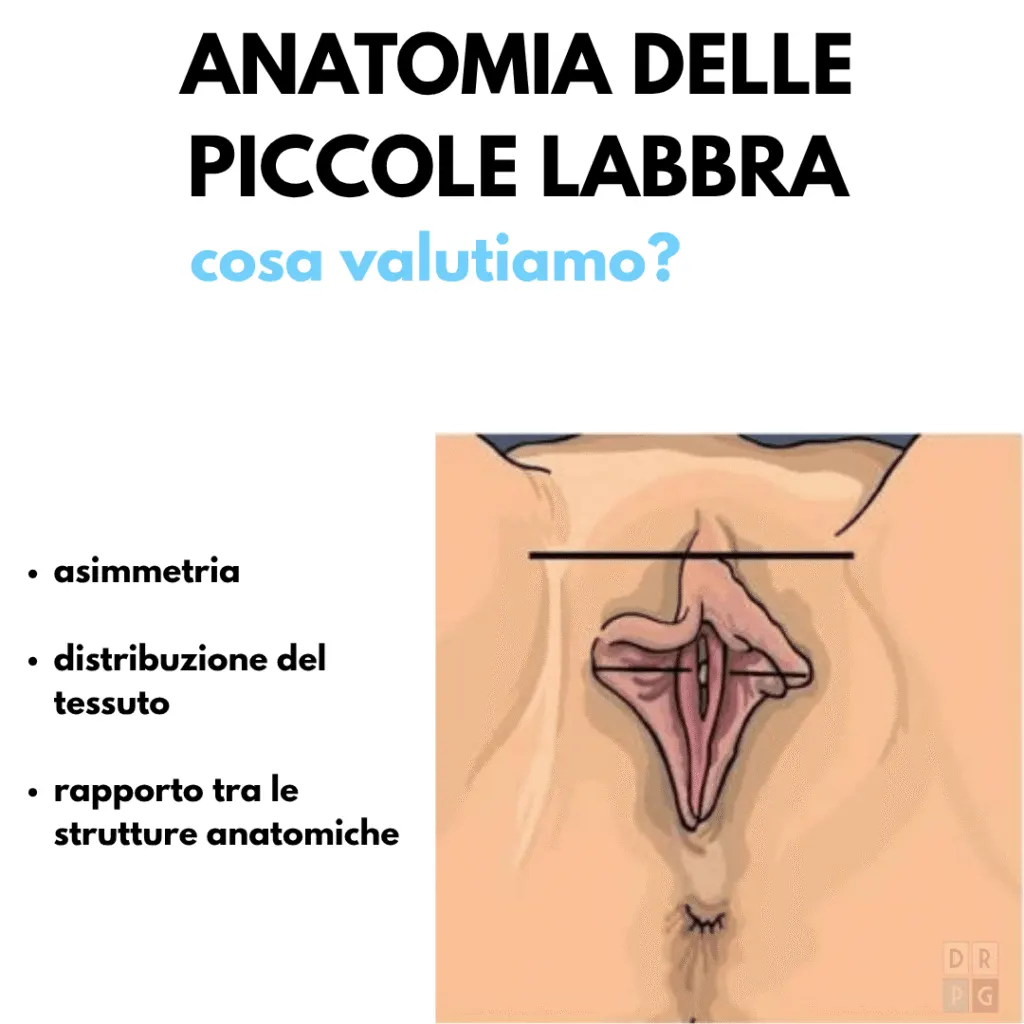
I rather observe:
shape and distribution of the tissue , any asymmetry , relationship between the labia minora and majora, characteristics of the lip margin, any excess surrounding skin and above all the relationship between anatomy and symptoms reported by the patient.
Another key point is to understand what is really bothering the patient.
One woman may have very developed labia minora without experiencing any discomfort. Another may have a less obvious anatomical variation but experience discomfort during certain activities.
For this reason, the decision should not be based solely on anatomical aspects.
When I don't recommend a labiaplasty
This is perhaps one of the most important parts of the visit.
Not all patients with protruding labia minora are suitable for labiaplasty.
If the anatomy falls within normal variability and does not cause any problems, surgery is not automatically necessary.
Likewise, it is important to explore unrealistic expectations or the desire to achieve a supposedly “perfect” anatomical model.
Images seen on social media, the internet, or in commercial communications can create a very limited representation of the true diversity of female anatomy. For this very reason, scientific societies recommend accurate information about normal anatomical differences before considering cosmetic genital surgery.
Surgery should be a conscious decision , not an attempt to conform perfectly normal anatomies to a single aesthetic model.
When can a labiaplasty be considered?

In appropriately selected adult patients, after a correct evaluation, a reduction labiaplasty can be considered.
To learn more about the procedure, the techniques used, and the postoperative recovery, you can read the complete guide to labiaplasty.
The goal is to reduce and reshape the labial tissue while preserving, as much as possible, anatomy, function and sensitivity.
The indication can be discussed when there are functional disorders related to anatomy or when the adult patient, adequately informed about the limitations and risks of the procedure, independently manifests significant aesthetic discomfort and realistic expectations.
The decision must however be individualized.
Labiaplasty: Is there a better technique?
No. I don't necessarily use the same technique on all patients.
Several surgical techniques have been described for labia minora reduction, including margin resections and wedge techniques, as well as numerous variations.
The choice depends on the starting anatomy and the surgical objective.
For example, they may be different:
- quantity and distribution of tissue;
- degree of asymmetry;
- characteristics of the labial margin;
- relationship with the clitoral hood;
- result that is realistically possible to achieve.
A recent systematic review analyzed different labiaplasty techniques and their outcomes; however, the literature does not allow for a single technique to be considered the universally best solution for all patients. PubMed
The patient's anatomy comes first, then the technique. Not the other way around.
Should the clitoral hood always be reduced?
No.
Clitoral hood reduction is a separate procedure and should not be automatically considered part of every labiaplasty.
During the examination, the relationship between the labia minora, the surrounding tissues and the clitoral hood must be assessed.
In some anatomies it may be appropriate to discuss it; in others there is no indication to intervene.
Again, the goal should not be to apply a standard regimen to all patients.
Can labiaplasty affect sensation?
This is one of the questions I consider most important before surgery.
Any surgical procedure on the genitals must be planned taking into account the nervous anatomy and tissue function.
Possible complications of genital surgery include changes in sensation , as well as pain, bleeding, infection, scarring, adhesions, dyspareunia, and the possible need for surgical revision. ACOG
Recent studies on sexual function after labiaplasty report overall favorable results in some study populations, but the quality of the evidence remains limited: a 2026 systematic review found 11 studies involving 671 participants, none of which were classified as methodologically strong. PubMed
For this reason, I would never promise a patient that labiaplasty will improve sensation or her sex life.
The surgical goal is to preserve function while addressing the problem for which the patient came to the surgeon.
Where do labiaplasty scars remain?
The location and extent of the scars depend on the technique used.
Vulvar tissues have different characteristics from the skin of other body regions and, with proper healing, the scars may become less visible.
However, there is no such thing as scar-free surgery.
The final quality of the scar depends on the technique, individual healing and the possible onset of complications.
This also needs to be explained before the procedure and not after.
Labiaplasty: Does it hurt?
During the procedure, an anesthesia appropriate for the procedure and the patient is used.
In the post-operative period , swelling, local sensitivity, tension and discomfort are possible , especially in the first few days.
The intensity varies from person to person.
Furthermore, initial swelling should not be confused with the final result: the tissues need time to heal and settle.
After labiaplasty, when can you return to sports and have sex?
The return to normal activities must be gradual and depends on the extent of the surgery and the progress of healing.
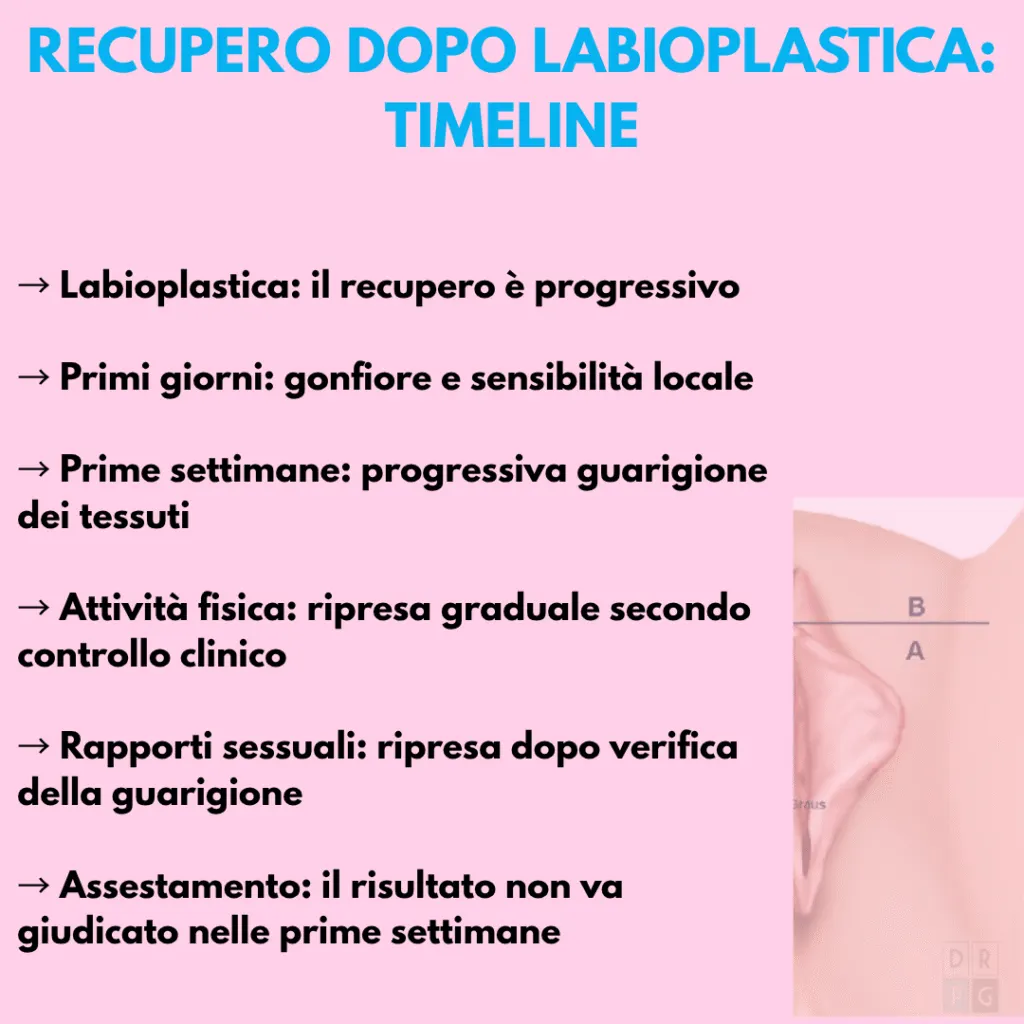
In the first few days it is generally necessary to avoid activities that cause pressure, rubbing or traction on the operated area.
Sports, cycling, and activities that directly stress the area should be resumed only after an evaluation of the healing process.
The same applies to penetrative sexual intercourse : I don't think it's appropriate to set the same date for all patients. Resumption of surgery is authorized based on tissue healing during postoperative checks.
What are the risks of labiaplasty?
Labiaplasty remains a surgical procedure.
Complications described include:
Bleeding, hematoma, persistent edema, infection, wound dehiscence, problematic scarring, residual asymmetry, pain, sensory changes, pain during intercourse, and the need for revision. ACOG
This does not mean that such complications will necessarily occur, but it does mean that they must be properly discussed during informed consent.
In this article, I have explored the indications and risks of this surgical procedure.
Protruding labia minora: so do I need surgery?
No: protrusion of the labia minora, by itself, does not represent a surgical indication.
The correct path is:
anatomy → possible symptoms → cause of the disorder → expectations → possible alternatives → indication → choice of technique.
Only at the end of this process can it be established whether a labiaplasty makes sense for that specific patient.
And this is precisely why two apparently similar women can receive different indications.
For those who wish to delve deeper into the topic, its progression and post-operative care, I have dedicated a specific page to labiaplasty.
Frequently asked questions about labia minora and labiaplasty
Yes. The labia minora can protrude beyond the labia majora, and this can be part of normal anatomical variability. Protrusion alone does not constitute a diagnosis or a surgical indication.
Yes. A certain asymmetry of the external genitalia is common. Further investigation is recommended when symptoms, recent changes, or significant discomfort are present.
There are size-based classifications, but there is no universal measurement that, by itself, determines the need for a labiaplasty.
In some anatomies, the tissue may be subjected to compression or rubbing during running, cycling, or other activities. Before attributing the problem to lip size, however, it's important to rule out other causes.
The goal may be to improve asymmetry, but absolute anatomical symmetry is not a realistic outcome to promise.
Altered sensation is a possible complication and should be discussed before surgery. The available evidence on the effects of labiaplasty on sexual function is still of limited quality. ACOG
No. It must be evaluated individually and is not automatically part of labiaplasty.
It depends on the healing process. Recovery should occur after the surgeon has verified proper tissue healing, avoiding applying the same timeframe to all patients.
The cost depends on the anatomical complexity, the technique, any association with other procedures, the type of anesthesia, and the facility where the surgery is performed.
Scientific bibliography:
- Nahidi F, Goodman MP, Alavi-Arjas F, Simbar M, Majd HA, Rastegar F. Female Sexual Function After Labiaplasty: A Systematic Review and Meta-analysis. Aesthetic Plast Surg. 2026 Jan;50(1):447-460.
Labiaplasty in Milan: A consultation is essential before deciding.
A visit for intimate surgery should not simply serve to confirm a surgical decision already made.
First of all, it helps us understand whether there really is a problem, what its cause is, and whether surgery is an appropriate option.
During the consultation, I evaluate the patient's anatomy, any functional problems, expectations, and possible alternatives. Only when there is a shared indication do we discuss technique, scarring, recovery, risks, and a realistically achievable outcome.
For those who want to learn more about where I perform the procedure, how I organize the initial visit, and the surgical process, I have dedicated a specific page to labiaplasty in Milan.
Do you think you need to talk about this?
If you recognize some of these characteristics, the visit first serves to understand whether it is really a hypertrophy of the labia minora and which strategy could be appropriate for your case.
I receive for surgical visits in Milan, Rome and Caserta.
The information contained in this article is for educational purposes only and does not replace a medical consultation. The clinical case described is individual and does not guarantee similar results in other patients. Indications, technique, course, and outcome may vary depending on the anatomy and individual characteristics.