
I share my clinical experience to help recognize and prevent risks
In recent years, I have increasingly seen patients come to my office in Milan after having had filler treatments performed. in unauthorized environments or from non-medical personnel.
Many of these people come to me because they have persistent swelling, lumps, infections, or facial changes.
Often they don't even know what kind of substance was injected, or whether it is an absorbable or permanent filler.
In these cases there is only one priority: make the patient safe, drain any infections and evaluate how to remove or neutralize the injected material.
The same applies to patients who, for various reasons, go abroad for surgery. I invite you to read the dedicated article!
Why do these complications happen?
Filler complications do not only arise from the product itself, but from how, where and by whom the treatment is performed.
The most frequent causes I encounter in my practice are:
- Use of non-CE certified products or of unknown origin
- Injections in incorrect anatomical locations (intravascular or too superficial)
- Lack of hygiene and absence of sterile protocol
- Treatments performed in private homes, beauty salons or apartments
- Absence of medical training and ability to manage emergencies
In some cases, the damage is not immediate: they may appear nodules or granulomas even months later.
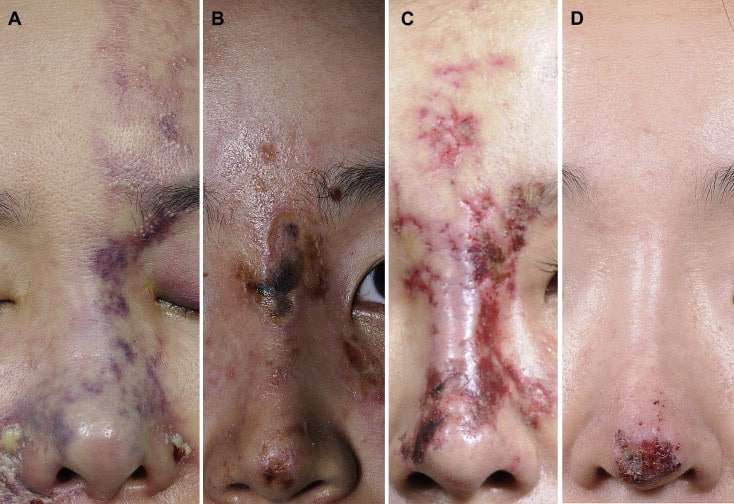
The most common filler complications I treat
| Type of complication | How it manifests itself | Most common cause | How I intervene |
|---|---|---|---|
| Infections | Pain, redness, heat, discharge, or abscess | Poor sterility, contaminated material | Drainage, targeted antibiotics, sometimes filler removal |
| Embolisms / ischemias | Pallor, severe pain, skin necrosis | Intravascular injection | Immediate treatment with hyaluronidase, vasodilators, oxygen |
| Granulomas / nodules | Induration, chronic swelling, asymmetry | Non-absorbable or impure material | Targeted enzyme or surgical therapy |
| Filler migration | Filler displaced, deformed or bulging | Excessive injection depth or excess product | Removal or remodeling with hyaluronidase |
| Allergic reactions | Itching, swelling, widespread redness | Uncertified substances or predisposition | Anti-inflammatory or corticosteroid drugs, clinical monitoring |

How do I deal with a complication?
The first step is always clinically evaluate the situation, often with ultrasound to locate the material.
When I find signs of infection or abscess, I proceed in a sterile environment to drainage and decontamination, followed by targeted antibiotic therapy.
👉 In the YouTube video linked to this article I show How do I drain a post-filler abscess? safely, illustrating the importance of a controlled environment and sterile instruments.
In the case of absorbable fillers, I use hyaluronidase to selectively dissolve the material.
If the product is permanent or unknown, the approach is more complex and may require minimal or laser-assisted surgical interventions.
All patients are monitored in the following days, until complete recovery.
How to prevent complications
True prevention is in choice of doctor and facility.
The filler is a medical act, non-aesthetic: requires anatomical knowledge and authorized environments.
In my studio Balance Clinic of Corso Buenos Aires in Milan, all treatments are performed:
- in room authorized by the Lombardy Region,
- with traceable and CE certified fillers,
- with constant presence of emergency kits and safety protocols.
Each procedure is also photographically documented to ensure transparency and traceability.
FAQ
No. In Italy, only licensed doctors can perform infiltrations. Anyone who does so without a license is committing a crime.
No. In Italy, only licensed doctors can perform infiltrations. Anyone who does so without a license is committing a crime.
Yes, in most cases with hyaluronidase or, if permanent, with selective microsurgery.
It is possible to reshape or dissolve the material, but a careful clinical evaluation and often multiple sessions are always required.
It must be absorbable, CE certified and injected only in authorized clinicsBe wary of anyone who doesn't provide product and batch information.
Useful links
Conclusion
Filler complications should not be trivialized, but managed competently and promptly.
If you have any doubts or suspect abnormal reactions, don't wait: every hour can make the difference between a small problem and permanent damage.
We receive patients daily for the evaluation and management of post-filler complications at our authorized healthcare facility in Milan.
There is only one goal: restore confidence, health and body confidence.
👉 Book a consultation with Dr. Pierluigi Gigliofiorito a Milan o Caserta for a personalized evaluation.
The information on this site is for informational purposes only and does not replace a doctor's opinion during a visit. Each treatment is individually assessed based on each individual case. Results may vary from patient to patient. No content is intended to be promotional or to encourage the performance of medical procedures.