
Fillers (especially those based on hyaluronic acid, HA) are among the most performed aesthetic medicine treatments in the world. The safety profile is high when performed by doctors (doctors/dentists in Italy), with certified products and in compliance with anatomy and asepsis. However, as with any procedure, there are contraindications and possible adverse events which is correct to know.
Controindicazioni
Controindicazioni absolute
- Known allergy to filler components or to the lidocaine contained in the product.
- Active infections at the treatment site (bacterial/viral/fungal dermatitis, active herpes).
- Inflammatory skin diseases in the acute phase on the area (e.g. eczema, active psoriasis in the area).
- Pregnancy e nursing (caution: lack of safety data).
- Procedures that cannot be performed in unsuitable environments or without emergency material (e.g. for vascular occlusion management).
Controindicazioni about (case-by-case evaluation)
- Coagulation disorders o anticoagulant/antiplatelet therapies (↑ risk of bruising/bleeding; possible management with the doctor).
- Autoimmune diseases/immunodeficiencies, immunosuppressive therapy (specialist evaluation).
- Tendency to hypertrophic/keloid scars (use caution, especially in high-risk areas).
- Invasive dental procedures imminent or recently performed (risk of bacteremia/biofilm: space by 2–3 weeks).
- Aggressive injections/lasers recent in the same location (define correct timing).
- Unrealistic expectations, body dysmorphic disorder: ethical/clinical contraindication.
Complications: classification and management
1) Immediate/transient (most common)
-
Edema, erythema, soreness, pruritus: typically 24–72 h.
- Management: intermittent ice, head elevated at night, possible NSAID/antihistamine if indicated.
-
Bruises: frequent in vascularized areas.
- Management: Arnica/vitamin K creams, camouflage; prevention: avoid NSAIDs/omega-3/alcohol 48–72 hours beforehand if possible.
2) Early (days–weeks)
-
Contour asymmetry/irregularity (edema, product placement/integration).
- Management: it often resolves; if it persists: modulation with micro-adjustments or hyaluronidase (for HA only).
-
Inflammatory reaction/hypersensitivity: redness, heat, pain.
- Management: clinical evaluation; rest, anti-inflammatories; rule out infection.
-
Reactivation of cold sores (lips/perioral).
- Management: antiviral therapy; prophylaxis in subjects with a history of relapses.
3) Infections (rare but important)
- Cellulite/Impetigo: pain, redness, heat, possible fever.
-
biofilm (low virulence bacteria): late nodules, intermittent inflammation.
- Management: Targeted antibiotics; prolonged courses are possible in biofilms, in combination with hyaluronidase (HA) and, sometimes, steroids/anti-inflammatories. Always consult a doctor.
4) Vascular events (rare but critical)
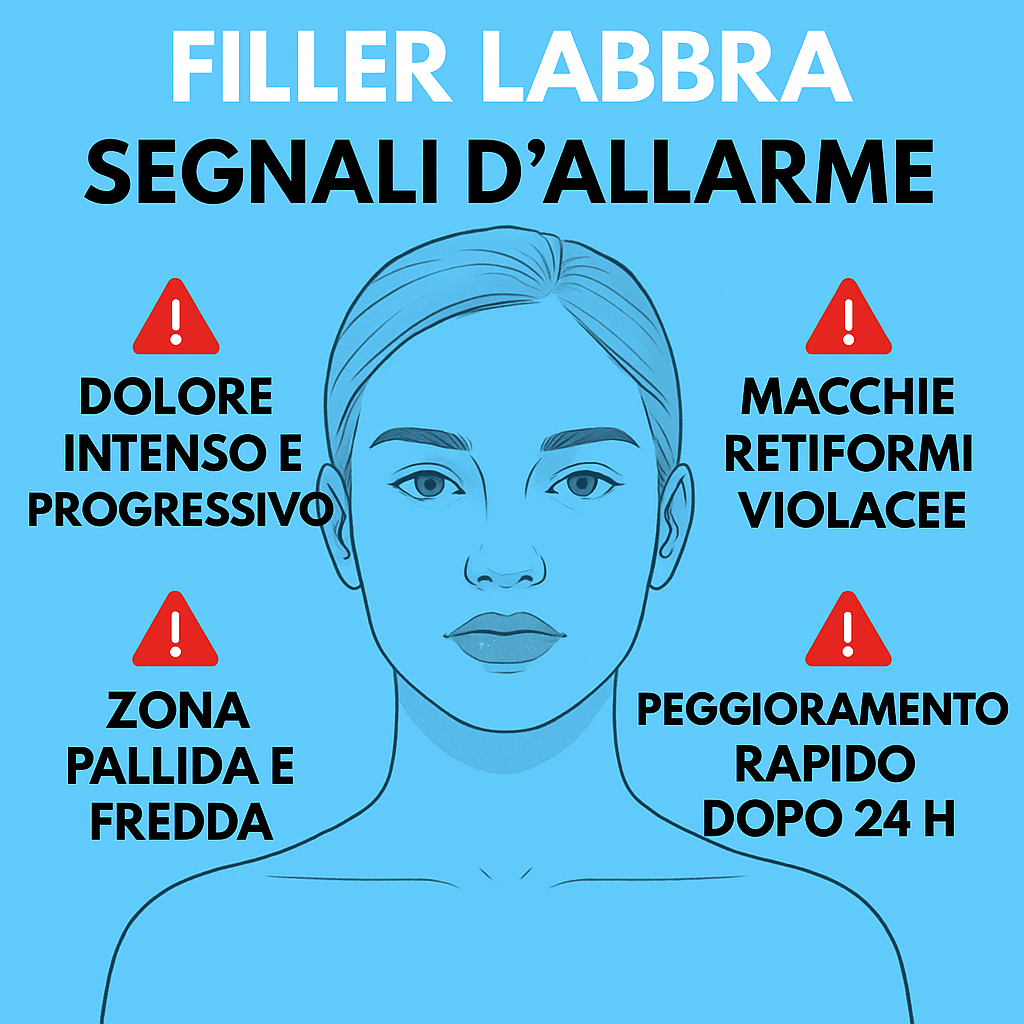
- Vascular occlusion (intravascular injection/compression): acute pain, reticular pallor/livedo, failure of capillary bleeding, rapid worsening; risk skin necrosis.
-
Ophthalmic involvement (extremely rare): sudden decrease in vision/eye pain → emergency.
-
Immediate management (basic protocol for HA):
- Suspend the procedure.
- High-dose hyaluronidase in and around the suspicious area, repeatable at short intervals (only if the filler is HA).
- Massage, heat local, evaluation of SO oral if not contraindicated, monitoring.
- Urgent postponement to an expert center/ophthalmologist if ophthalmic suspicion.
- Prevention: appropriate cannula/needle, micro‑boluses, low pressure, selective aspiration (debated), knowledge of danger zones.
-
Immediate management (basic protocol for HA):
5) Late (weeks–months)
-
Nodules/granulomas: foreign body or immune-mediated reaction.
- Management: for HA: hyaluronidase ± corticosteroids/antibiotics according to the table; for non-HA (CaHA/PLLA): different regimen (no hyaluronidase).
-
Tyndall Effect (blue-greyish halo due to too superficial injection with HA).
- Management: low-dose localized hyaluronidase.
-
Filler migration (rare; technique/area/overcorrection).
- Management: hyaluronidase (HA), technical review/timelines.
Quick Table – Complication & First Conduct
| Complication | signs | What to do immediately |
|---|---|---|
| Edema/erythema | Swelling, redness | Intermittent ice, rest, follow-up |
| Bruises | Bruise | Arnica/vit. K, avoid heat/sauna 48 hours |
| Asymmetry/irregularity | Uneven contours | Wait 10–14 days; then micro-correction or hyaluronidase (HA) |
| Infection | Pain, heat, fever | Medical evaluation, antibiotics; NO massages |
| Nodules/granulomas | Hard nodules | Evaluation; hyaluronidase (HA) ± steroids/ATB |
| Vascular occlusion | Sharp pain, livedo/pallor | Emergency protocol, high-dose hyaluronidase, urgent referral |
| tyndall | Blue halo | Targeted hyaluronidase |
Note: la hyaluronidase It is only effective on fillers based on hyaluronic acid.
As a reduce the risk di complications (for the patient)
- Complete anamnesis (allergies, therapies, pathologies, herpes).
- Suspend when possible (and if approved by the doctor) NSAIDs/aspirin/omega-3/alcohol 48–72 hours before.
- No makeup on the area on the day of treatment; intact skin and disinfected.
- After the filler: no intense sports/sauna/high temperatures for 24 hours, no makeup for 6 hours, photoprotection high.
FAQ
Yes, if performed by experienced doctors with certified products and in a suitable environment. Serious events are rare.
Pregnancy/breastfeeding, active infections at the site, known allergies to the components, acute inflammatory skin diseases.
Common and transient events (edema, bruising); more rare: nodules, infections, vascular occlusions. Your doctor will explain how to prevent and treat them.
With thehyaluronic acid it is often possible to modulate or dissolve the product with hyaluronidase.
Typically after 10–14 days (time for edema to reabsorb and product integration).
The information on this site is for informational purposes only and does not replace a doctor's opinion during a visit. Each treatment is individually assessed based on each individual case. Results may vary from patient to patient. No content is intended to be promotional or to encourage the performance of medical procedures.